
The Vanishing Art Behind Quiet Luxury
Quiet luxury has become the phrase of the decade, usually applied to anything without a visible logo. The harder version of the idea is older, and far easier to claim than to deliver: that the worth of an object lives in how it was made, by whom, and whether anyone can still make it at all.
The claiming half of that sentence is easy. A house can remove the logo, mute the palette, raise the price; it can commission the atelier film, speak of heritage, and cut production until scarcity looks like discipline. The delivering half rests on human skill that takes decades to form and cannot be bought ready-made. The clearest case is close to extinction: a leather-finishing technique that appears on fewer than one in ten thousand leather goods made today, takes as long as thirty years to master, and survives at the highest standard in vanishingly few hands worldwide. Two questions follow. Why is it disappearing? And what would keeping it actually take?
The technique is called rempliage, known in English as the folded edge or turned edge, and its significance is easier to see against the alternatives. Every leather edge has to be finished somehow, and there are broadly three ways to do it. The edge can be left raw, cut and bare. It can be painted, sealed under a thin film of pigment that covers the cut. Or it can be folded back on itself, so that no cut edge remains to be treated at all. Most of the industry, luxury included, paints, and the reason is industrial, not aesthetic. Painting is fast, repeatable, and possible at any volume with ordinary training; folding the same edge takes more than ten times as long and demands master artisans who do not exist in industrial numbers. A house producing at modern scale could not staff rempliage if it wanted to. The choice makes itself.
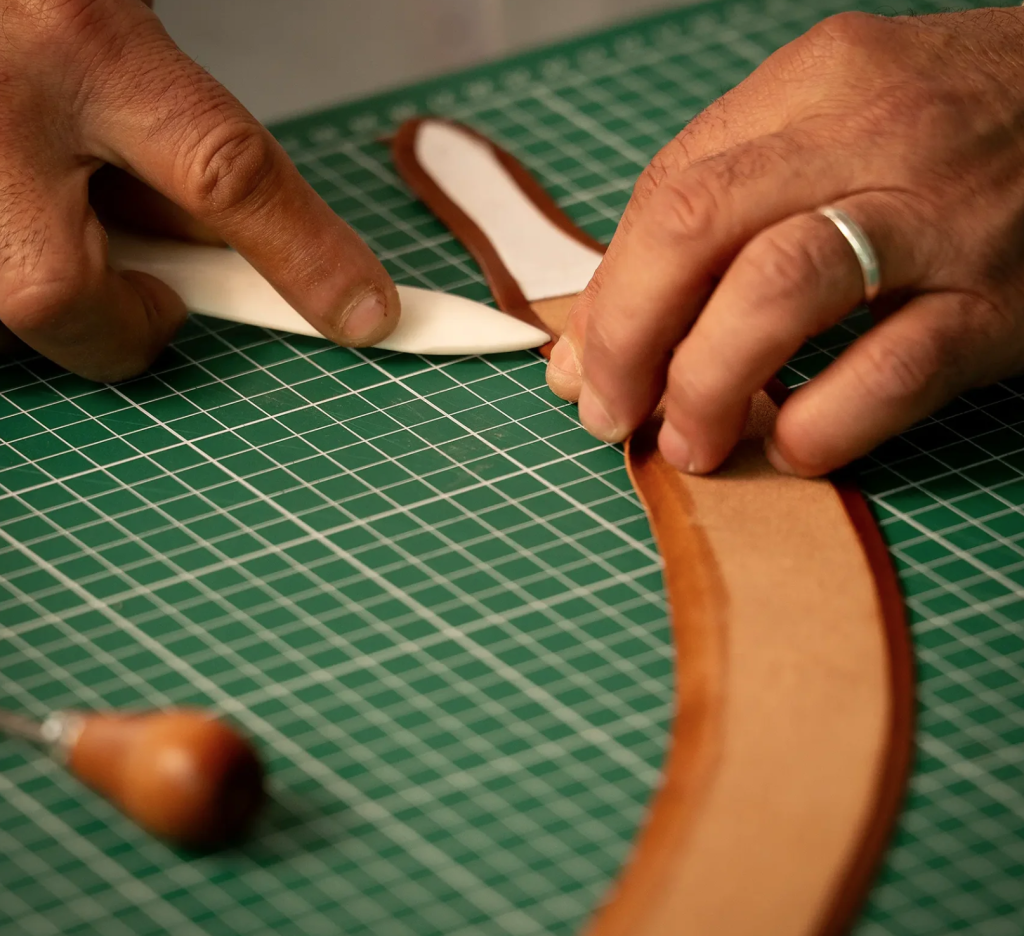
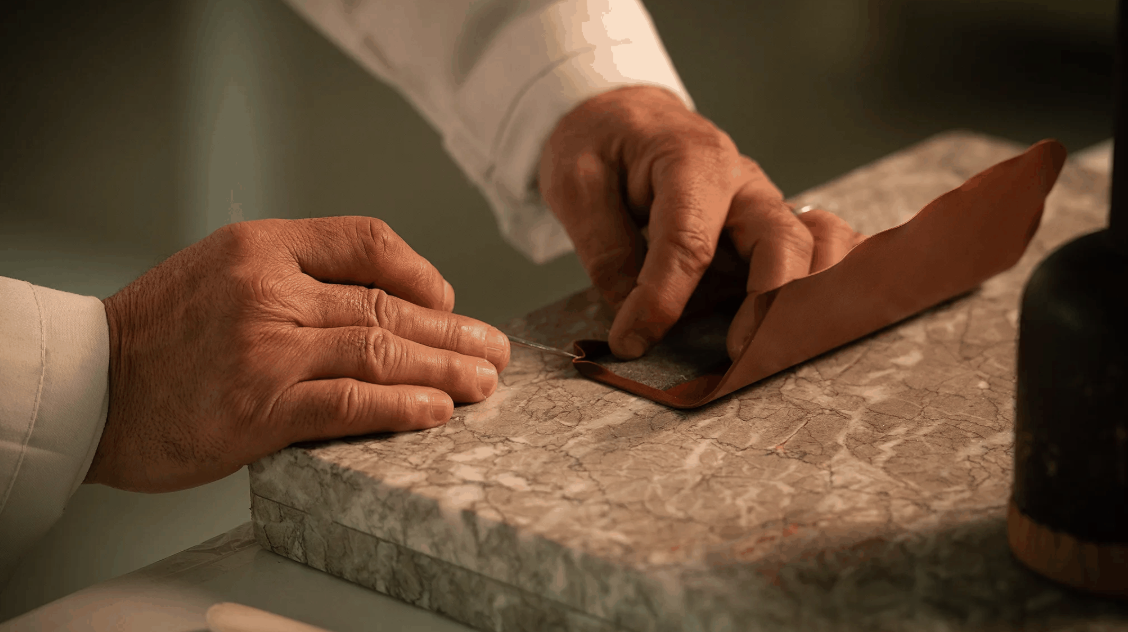
Rempliage takes the slow path. The leather is first skived, pared down to within a tenth of a millimetre of the intended thickness, with up to four distinct skiving configurations on a single panel. It is then folded and hammered until the edge dissolves into the form, a step artisans call the dead edge. Every one of those operations is irreversible; a slip at any point ruins the panel.
And because nothing is applied, there is nothing to crack and nothing to peel: only leather folded upon leather, the grain flowing unbroken from the outside of the object to the inside. A painted edge is a separate substance with a separate lifespan, and it ages against the leather rather than with it. A folded edge ages exactly as the surface does, so that after twenty years the edge and the body of a piece are indistinguishable in how they have grown old. This is the substance the look of restraint gestures at. It can be imitated on the day of purchase; it cannot be imitated a few years in.
Where such hands are still formed is not incidental, and the industry’s own vocabulary quietly admits it: the French word for fine leatherwork, maroquinerie, translates literally as Moroccan work. It points to Fes, an imperial capital of Morocco across successive dynasties and, for centuries, the centre of the leatherworking world. The city’s guilds worked in the orbit of the University of Al-Qarawiyyin, founded in 859, where the men who cut and folded leather were trained in geometry and the craft was treated as applied mathematics. Families took their names from the work itself: Debbagh, the tanner; Sarrāj, the saddler; Kharraz, the stitcher. When Granada fell in 1492, Andalusia’s master leatherworkers fled south to Fes and folded nine centuries of refinement into the city’s own. The folded edge was perfected there over roughly a millennium before it entered European saddlery in the eighteenth century. Europe kept the technique, kept the word, and simply stopped hearing what the word said.
Why the craft is dying is a question of arithmetic more than taste, and the plainest statement of it comes from a man who left another industry to act on it. Amien Marghich, a former senior engineer at Google, founded Lunburg, a maison of Dutch and Moroccan parentage, on a blunt diagnosis. In the prevailing model, as he describes it, the work reaches the artisan through layer upon layer of intermediaries, and each layer takes its share, so the hands that actually make the object receive a sliver of the value it sells for. And because most houses order painted edges, the cheapest finish to produce, there is less and less call for the advanced techniques that take a career to learn; the mastery that cost thirty years to build commands less work, and less pay, with every passing year.
The consequences compound across generations. An apprentice is paid from the first day, he notes, but paid very little; through the learning years the wage is a fraction of what the work will one day deserve. Competence in rempliage takes around ten years to reach; mastery takes the better part of two decades more; and those are years of small pay for skills of rising rarity. And the children, he says, watching what the craft paid their parents, are declining to inherit it. In his telling, the brand appears at the last step of the pipeline, buys what is finished, and sells the story of hands it never helped to train. A craft that pays its future less than a living will, quietly and inevitably, stop reproducing itself; the masters now working may be the last generation to hold the technique at its height.
Lunburg’s answer is to commit forty per cent of profit to the craft’s preservation, from the masters still working in Fes to the apprentices who will one day replace them. Marghich files the figure under cost of production, not generosity: if the masters go unfunded there are no apprentices, and if the apprentices go there is no one left to make the thing at all. Keeping the craft, in other words, is not a gesture attached to the business. It is the business.
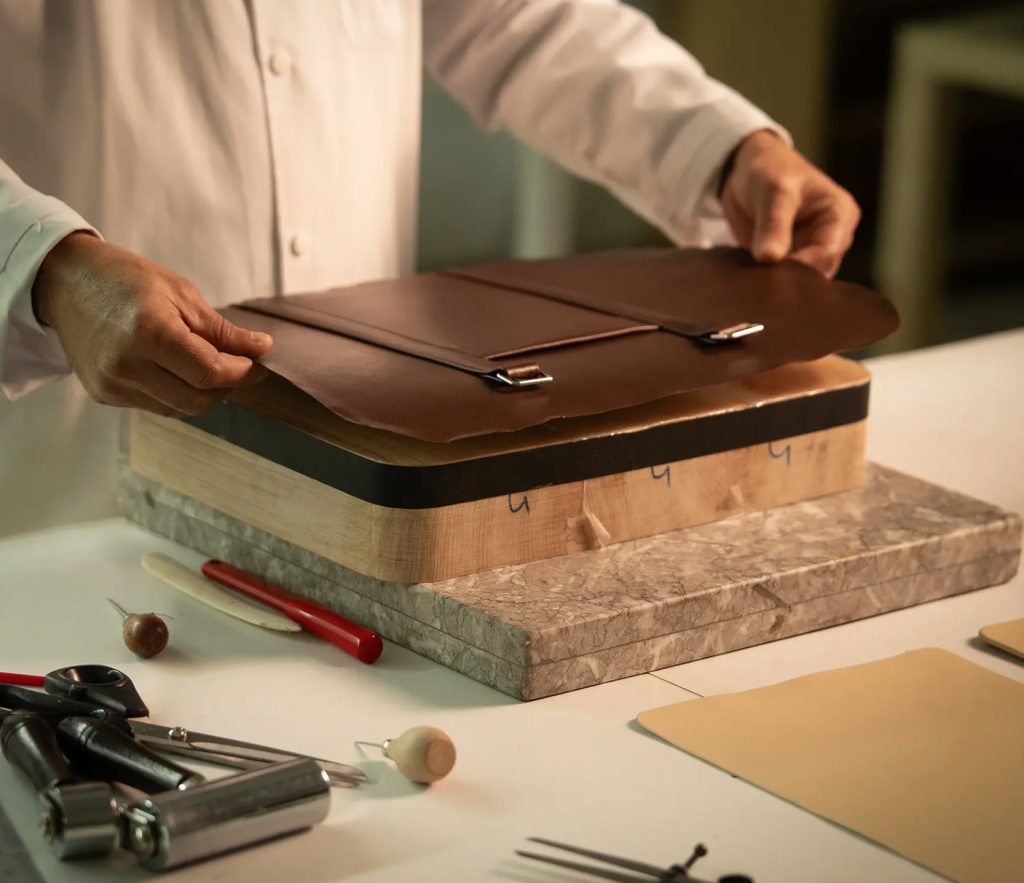
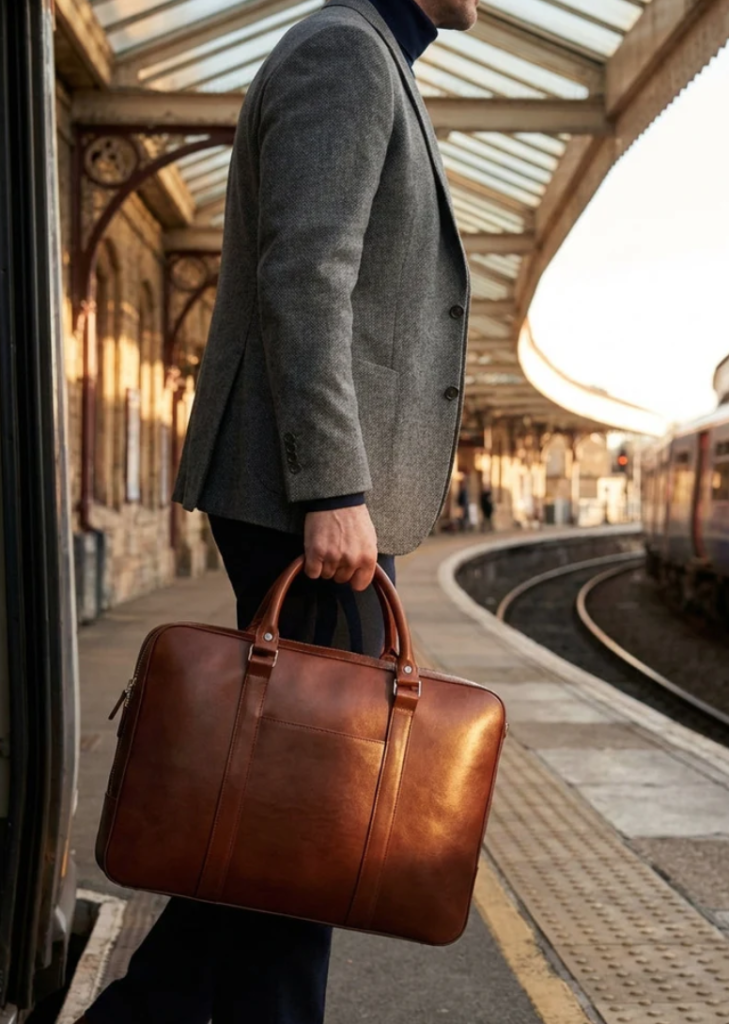
The objects are built to bear the weight of that argument. The leather is tanned the slow way, in Tuscany, across some forty days in wooden drums of chestnut and mimosa extract, at a time when most of the world’s leather is tanned industrially in a matter of hours. The construction is done entirely by hand in Fes. The house’s flagship briefcase, the Opus, carries some thirty metres of hand-folded edge across 140 hand-cut panels and 1,233 consecutive steps, around sixty-six hours of artisan labour in all; Lunburg calls it a grand complication, borrowing the watchmaker’s term for a mechanism at the outer limit of what hands can do.
That is the quiet part of quiet luxury, and the part a logo cannot counterfeit. An object finished this way is less a purchase than a fragment of a living tradition, made to outlast the person who owns it. In a market crowded with the appearance of restraint, the rarer thing is the craft beneath it, still practised by the few hands that remember how it is done.
Explore more with Luxury Life, your luxury lifestyle magazine for design, travel and fine living.




One Response